
Learning objectives
- Define SNR and why it limits image quality
- Apply the main SNR proportionalities
- Predict how a protocol change affects SNR and scan time
What SNR means
SNR compares the size of the useful MR signal with the random noise in the image. Low SNR makes images grainy and hides small or low-contrast detail. Most protocol choices trade SNR against resolution or scan time.
The core relationship
With other factors fixed, a common working form is:
SNR ∝ voxel volume × √(number of averages × phase steps) / √(receiver bandwidth)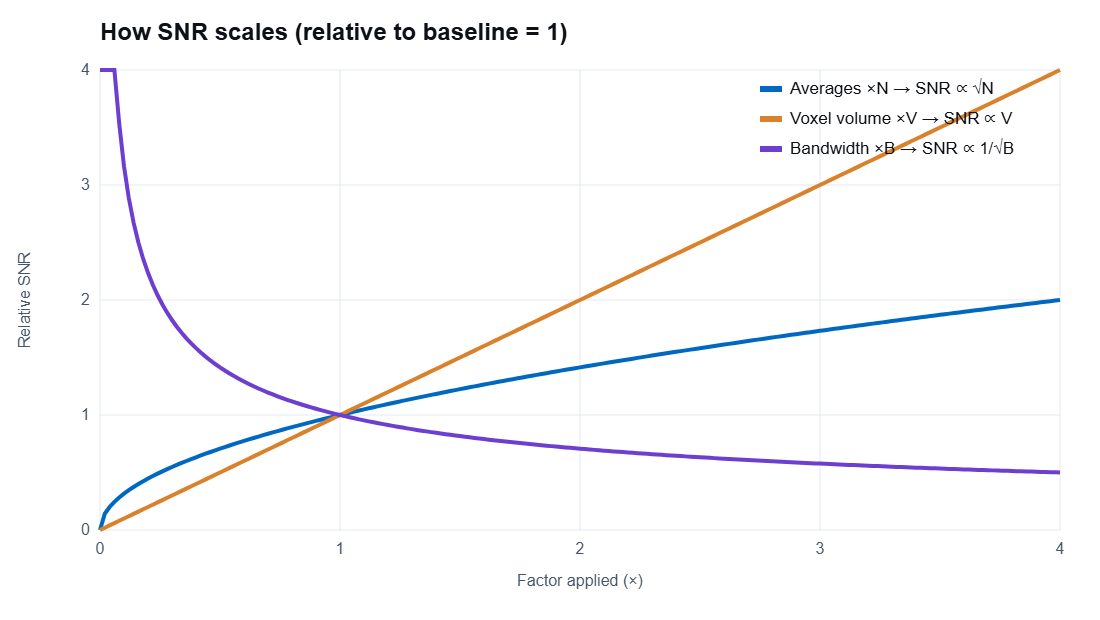
Levers you can pull
| Change | Effect on SNR | Cost |
|---|---|---|
| Double voxel volume | About ×2 | Lower resolution, more partial volume |
| Double averages | About ×1.41 (√2) | Double scan time |
| Halve bandwidth | About ×1.41 | Longer readout, more chemical shift and distortion |
| Higher field strength | Increases (roughly with B0 in many regimes) | More susceptibility and SAR challenges |
| Better-matched coil (for example multichannel head coil) | Often a large gain near the coil | Coil availability and uniformity |
Worked example
Going from a 1 × 1 × 3 mm voxel (3 mm³) to 0.8 × 0.8 × 3 mm (1.92 mm³) multiplies SNR by about 1.92/3 = 0.64. To recover it with averages you would need about (1/0.64)² ≈ 2.4 times as many, so scan time grows about 2.4 times. This is why higher resolution is expensive.
Key takeaways
- SNR scales linearly with voxel volume
- SNR scales with the square root of averages, so doubling SNR costs four times the time
- Narrower bandwidth helps SNR but has side effects
FAQ
Is SNR the same as contrast?
No. Contrast-to-noise ratio (CNR) is what lets you separate two tissues; high SNR with poor contrast still hides differences.
Does parallel imaging reduce SNR?
Yes. Acceleration shortens scans but lowers SNR, by at least the square root of the acceleration factor plus a geometry-dependent penalty.
References
- Edelstein WA, Glover GH, Hardy CJ, Redington RW. The intrinsic signal-to-noise ratio in NMR imaging. Magn Reson Med 1986;3:604-618.
- Brown RW, Cheng YCN, Haacke EM, Thompson MR, Venkatesan R. Magnetic Resonance Imaging: Physical Principles and Sequence Design, 2nd ed. Wiley; 2014.
Educational disclaimer: values and parameters here are illustrative and vary by scanner, field strength, vendor and protocol. This article is for learning and is not clinical advice.