
MRI Physics Basics
-
MRI Physics
Signal-to-Noise Ratio in MRI: What Changes It and Why
A practical guide to MRI signal-to-noise ratio: how voxel size, averages, bandwidth, field strength and coils change SNR, with worked examples.
Read More » -
MRI Physics
Diffusion MRI Basics: b-values, DWI and the ADC Map
How diffusion-weighted imaging works: the diffusion gradients, what the b-value means, why signal falls with diffusion, and how the ADC map is calculated.
Read More » -
MRI Physics
Spin echo versus gradient echo: two ways to form an MRI signal
How spin-echo and gradient-echo sequences form signal, why T2 and T2* differ, and how each affects artefacts and speed.
Read More » -
MRI Physics
T1 and T2 relaxation explained: why tissues look different on MRI
How T1 and T2 relaxation, TR and TE create the contrast in MRI, with illustrative curves and a weighting table.
Read More » -
MRI Physics
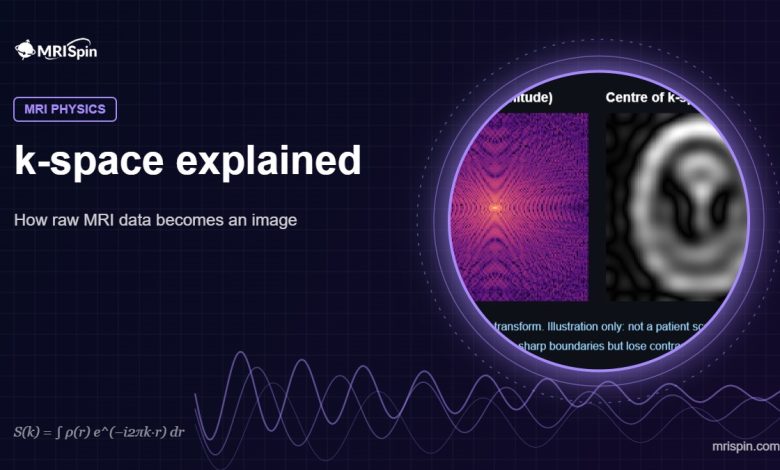
k-space explained: how raw MRI data becomes an image
What k-space is, what its centre and edges control, and how sampling sets resolution, field of view and scan time.
Read More » -
MRI Physics
Larmor frequency explained: why MRI works at radio frequencies
How the Larmor equation links magnetic field strength to the radio frequency an MRI scanner uses, with worked examples for hydrogen and sodium.
Read More »