Write a Reproducible Methods Section with SpinLab’s Methods Generator

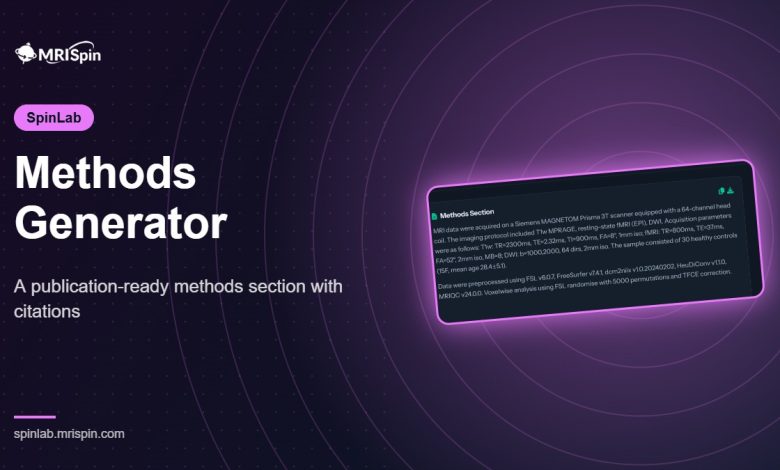
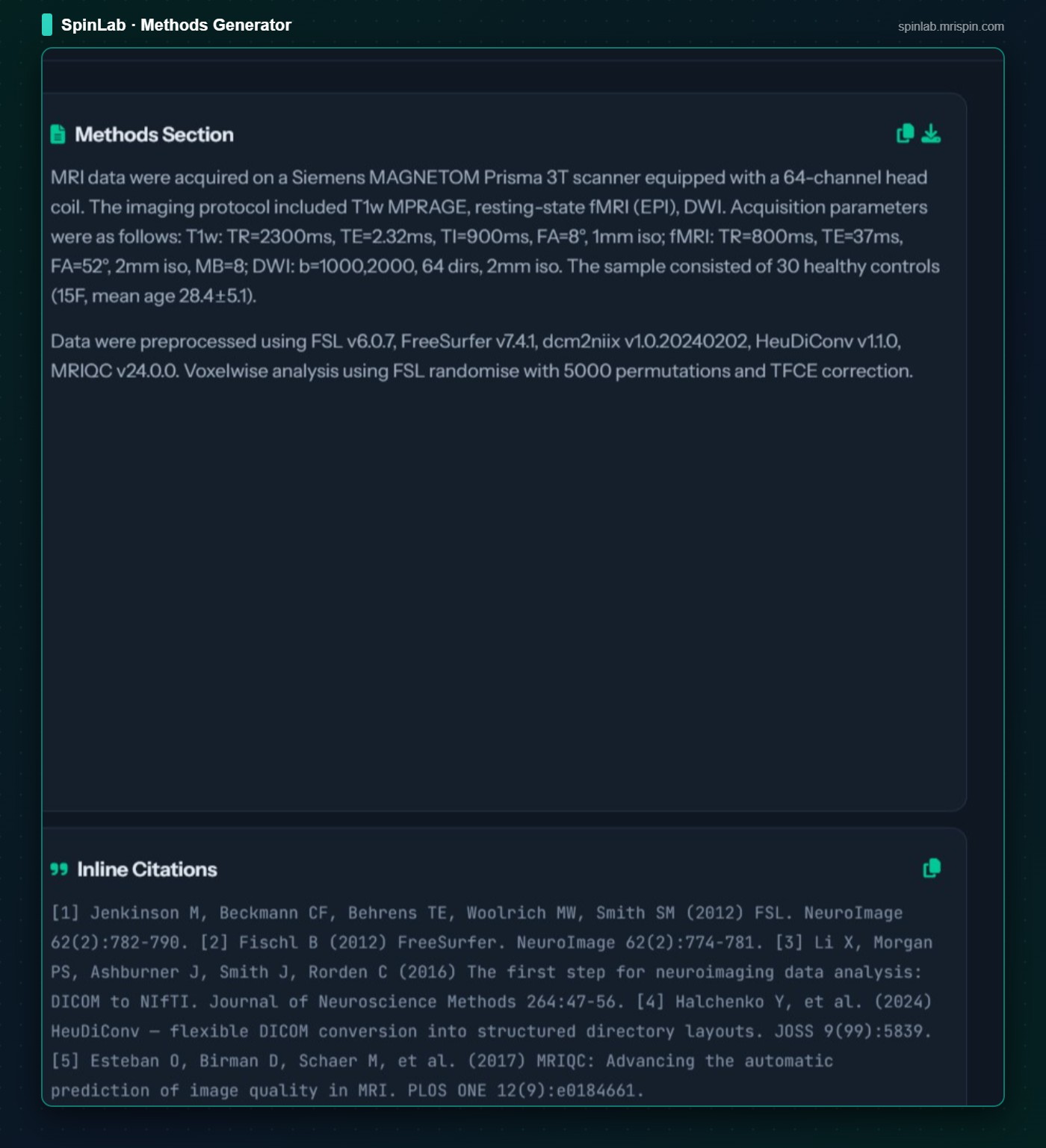
The methods section is where reviewers check that your analysis can be repeated, and where software authors expect credit. Writing it by hand means hunting for version numbers, parameters and the right citation for every tool. The SpinLab Methods Generator builds a draft paragraph from the tools and settings you choose, and lists the matching references.
Step by step
- Open spinlab.mrispin.com and choose Methods Generator.
- Select the scanner details, the sequences and the software you used.
- Fill in the key parameters (for example smoothing kernel, registration and thresholds).
- Copy the generated paragraph and the reference list into your manuscript.
- Edit the text so it matches exactly what you did, and add versions for every tool.
References the generator includes
| Tool | Reference |
|---|---|
| FSL | Jenkinson M, Beckmann CF, Behrens TEJ, Woolrich MW, Smith SM. FSL. NeuroImage 2012;62(2):782–790. |
| FreeSurfer | Fischl B. FreeSurfer. NeuroImage 2012;62(2):774–781. |
| dcm2niix | Li X, Morgan PS, Ashburner J, Smith J, Rorden C. The first step for neuroimaging data analysis: DICOM to NIfTI conversion. J Neurosci Methods 2016;264:47–56. |
| HeuDiConv | Halchenko YO, et al. HeuDiConv — flexible DICOM conversion into structured directory layouts. J Open Source Softw 2024;9(99):5839. |
| MRIQC | Esteban O, et al. MRIQC: Advancing the automatic prediction of image quality in MRI from unseen sites. PLoS One 2017;12(9):e0184661. |
Find the versions you actually used
A citation without a version is incomplete, because results can change between releases. These commands print the installed versions:
cat $FSLDIR/etc/fslversion        # FSL
recon-all -version                 # FreeSurfer
dcm2niix -v                        # dcm2niix
heudiconv --version                # HeuDiConv
mriqc --version                    # MRIQC
If you used containers, cite the image tag too (for example the Docker or Apptainer image name and version).
A checklist for a reproducible methods section
- Scanner, field strength, coil and every sequence parameter that matters (TR, TE, flip angle, voxel size, acceleration).
- Software names, versions and citations.
- Every preprocessing step in order, with its key options.
- Statistical model, contrasts, correction for multiple comparisons and thresholds.
- Quality-control rules and how many scans were excluded.
- Where the code and, if allowed, the data can be found.
The generated text is a draft. You are responsible for checking that every sentence describes what you did.
Related: quality control and building the pipeline you will describe.
Last reviewed: 7 November 2026. SpinLab and SpinCalc are free tools developed by MRISpin. Screenshots show the tools as they were on this date and may change as the tools are updated. Generated scripts should be checked before use on real data.