eGFR with CKD-EPI 2021: A Step-by-Step Guide with SpinCalc

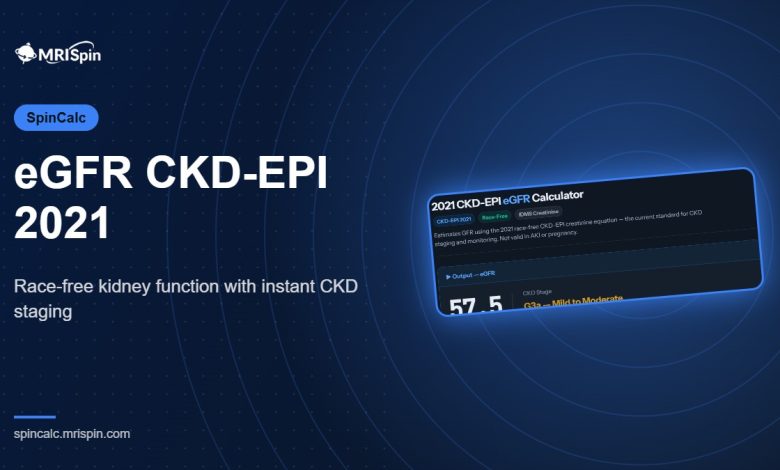
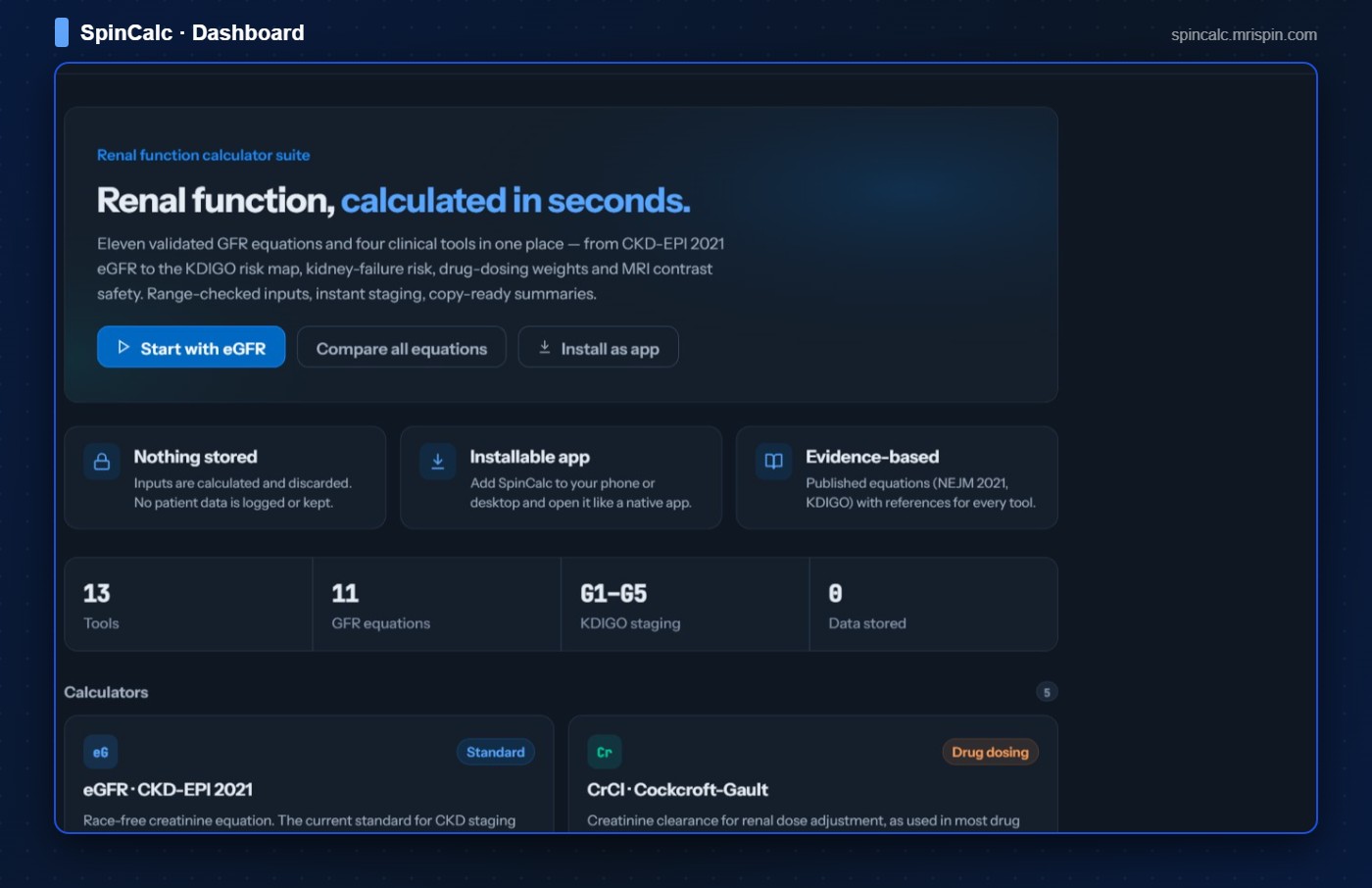
Before a contrast-enhanced MRI, many departments check kidney function. The number they use is the estimated glomerular filtration rate (eGFR), worked out from serum creatinine, age and sex. SpinCalc is MRISpin’s free renal calculator suite: eleven GFR equations and four clinical tools in one place. This guide covers the equation most labs now report, CKD-EPI 2021.
Why CKD-EPI 2021?
The 2009 CKD-EPI equation included a race coefficient. In 2021 Inker and colleagues published a refit without race, and US kidney organisations recommended moving to it. It uses the same inputs (creatinine, age and sex) and needs no race information.
The equation
eGFR = 142 × min(SCr/κ, 1)^α × max(SCr/κ, 1)^−1.200 × 0.9938^Age × 1.012 [if female]

SCr  serum creatinine in mg/dL
κ    0.7 (female) or 0.9 (male)
α    −0.241 (female) or −0.302 (male)
unit mL/min/1.73 m²
If your lab reports creatinine in µmol/L, divide by 88.4 to get mg/dL.
Step by step in SpinCalc
- Open spincalc.mrispin.com and choose CKD-EPI 2021.
- Enter serum creatinine and choose the unit.
- Enter age and sex.
- Read the eGFR and the CKD stage shown beside it.
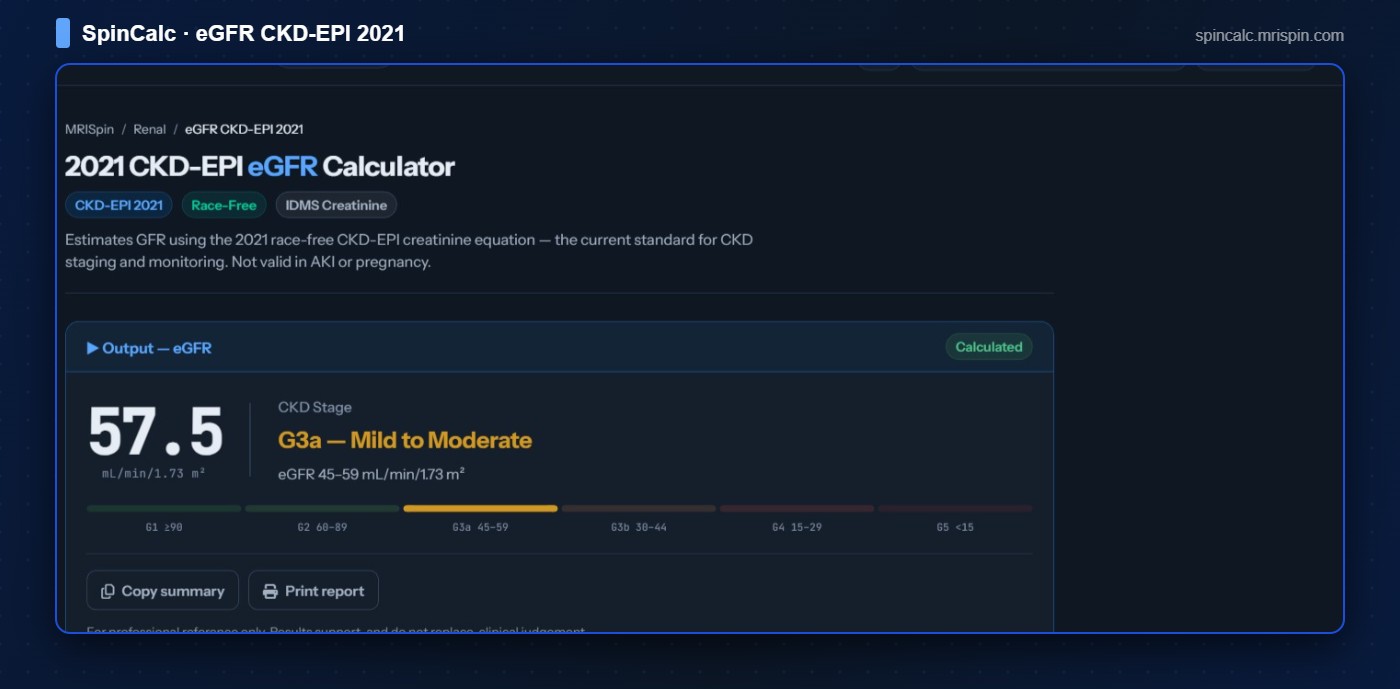
For a 60-year-old woman with creatinine 1.1 mg/dL, SpinCalc gives 57.5 mL/min/1.73 m², stage G3a. A man of the same age and creatinine would have an eGFR of about 76.9, which shows how much the sex terms matter.
Check it in Python
def ckd_epi_2021(scr_mg_dl, age, female):
    k = 0.7 if female else 0.9
    a = -0.241 if female else -0.302
    r = scr_mg_dl / k
    egfr = 142 * min(r, 1) ** a * max(r, 1) ** -1.200 * 0.9938 ** age
    return egfr * 1.012 if female else egfr

print(round(ckd_epi_2021(1.1, 60, True), 1))   # 57.5
print(round(ckd_epi_2021(1.1, 60, False), 1))  # 76.9
GFR categories (KDIGO)
| Category | eGFR (mL/min/1.73 m²) | Description |
|---|---|---|
| G1 | ≥ 90 | Normal or high |
| G2 | 60–89 | Mildly decreased |
| G3a | 45–59 | Mildly to moderately decreased |
| G3b | 30–44 | Moderately to severely decreased |
| G4 | 15–29 | Severely decreased |
| G5 | < 15 | Kidney failure |
Limits to keep in mind
- eGFR assumes stable kidney function. It is not reliable in acute kidney injury, when creatinine is changing.
- Very high or low muscle mass (bodybuilders, amputees, frailty) shifts creatinine and so the estimate.
- The result is indexed to 1.73 m² body surface area; drug dosing sometimes needs the non-indexed value.
- Calculators support clinical decisions; they do not replace local policy or clinical judgement.
Next: use the eGFR to check gadolinium safety and KDIGO risk.
References
- Inker LA, Eneanya ND, Coresh J, et al. New creatinine- and cystatin C–based equations to estimate GFR without race. N Engl J Med 2021;385(19):1737–1749.
- Kidney Disease: Improving Global Outcomes (KDIGO) CKD Work Group. KDIGO 2024 Clinical Practice Guideline for the Evaluation and Management of Chronic Kidney Disease. Kidney Int 2024;105(4S):S117–S314.
Last reviewed: 7 November 2026. SpinCalc is a free tool developed by MRISpin. Screenshots show the tool as it was on this date. For education and decision support only; follow your local policy.