Gadolinium Safety and CKD Risk: SpinCalc’s MRI Contrast Check and KDIGO Tools

Gadolinium-based contrast agents (GBCAs) make many MRI scans possible, but in patients with poor kidney function some older agents were linked to nephrogenic systemic fibrosis (NSF), a rare and serious condition. Today the risk depends mainly on which agent is used. SpinCalc’s MRI Contrast Check combines the agent’s ACR group with the patient’s eGFR, and its KDIGO tool places the patient on the CKD risk heat map.
ACR groups of gadolinium agents
| Group | NSF risk | Examples |
|---|---|---|
| Group I | Highest number of NSF cases | Gadodiamide, gadopentetate dimeglumine, gadoversetamide (largely withdrawn from use) |
| Group II | Very few, if any, unconfounded NSF cases | Gadobenate dimeglumine, gadobutrol, gadoterate meglumine, gadoteridol |
| Group III | Limited data | Gadoxetate disodium |
For group II agents, the ACR Manual on Contrast Media states that the risk of NSF is so low that screening for kidney disease before use is optional. For group I agents the advice is much more restrictive, and for group III there are fewer data.
Step by step: MRI Contrast Check
- Open spincalc.mrispin.com and choose MRI Contrast Check.
- Select the contrast agent.
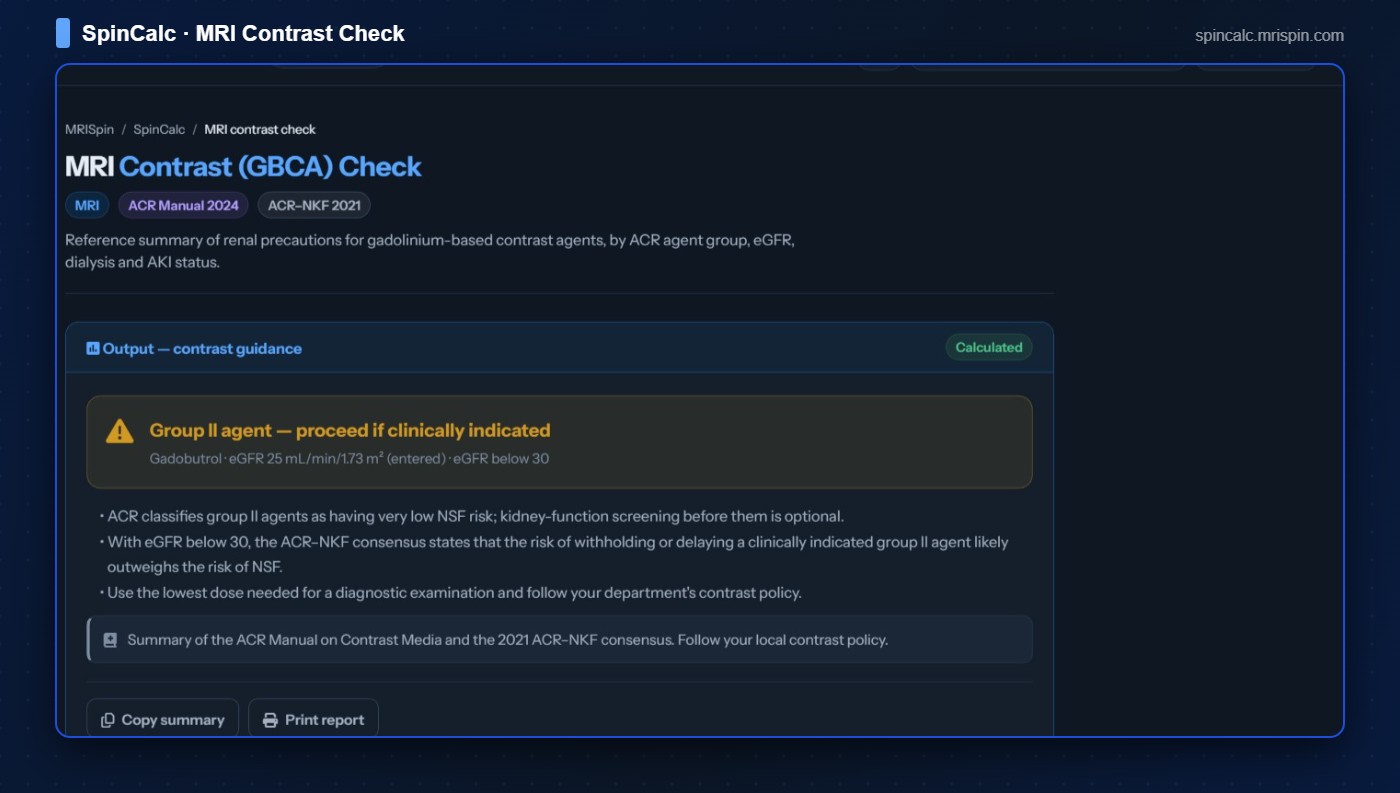
- Enter the eGFR, or calculate it first with CKD-EPI 2021.
- Read the guidance and the source it is based on.
In the example above, gadobutrol (group II) at an eGFR of 25 mL/min/1.73 m² returns proceed if clinically indicated, in line with the ACR Manual (2024) and the 2021 ACR–NKF consensus statement.
Step by step: KDIGO risk heat map
KDIGO classifies chronic kidney disease by two measures together: GFR category (G1–G5) and albuminuria category (A1–A3, from the urine albumin-to-creatinine ratio, ACR).
| Albuminuria | ACR (mg/g) | Description |
|---|---|---|
| A1 | < 30 | Normal to mildly increased |
| A2 | 30–300 | Moderately increased |
| A3 | > 300 | Severely increased |
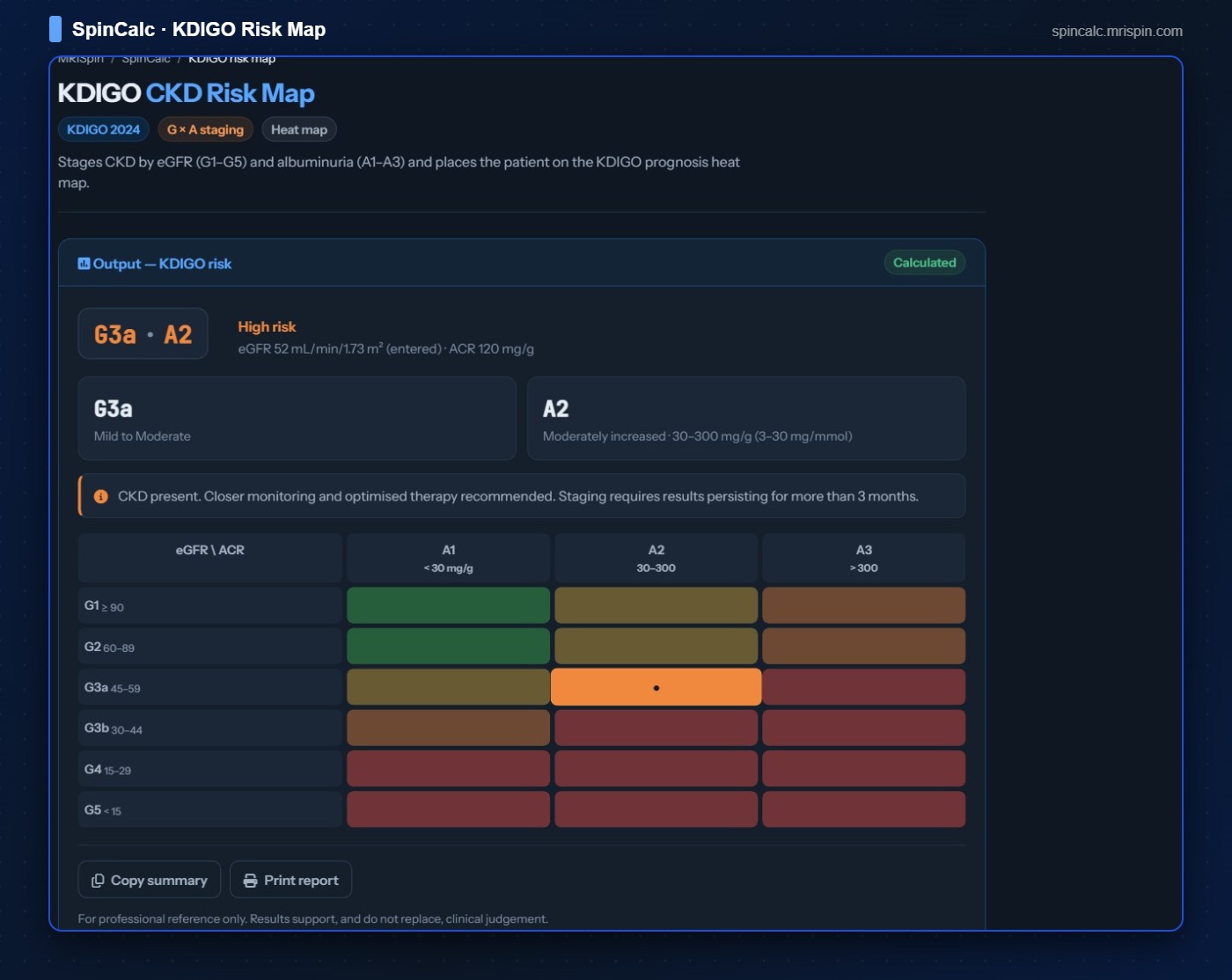
An eGFR of 52 with an ACR of 120 mg/g places the patient at G3a A2, the orange “high risk” cell of the heat map. The colour summarises the risk of CKD progression and related complications.
Putting it together before a contrast MRI
- Check whether the patient has a recent creatinine result, if your local policy requires one.
- Calculate eGFR with CKD-EPI 2021.
- Check the planned agent and its ACR group.
- For patients on dialysis or with acute kidney injury, follow the specific local guidance and involve the referring team.
- Record the agent, dose and justification.
References
- ACR Committee on Drugs and Contrast Media. ACR Manual on Contrast Media. American College of Radiology, 2024.
- Weinreb JC, Rodby RA, Yee J, et al. Use of intravenous gadolinium-based contrast media in patients with kidney disease: consensus statements from the American College of Radiology and the National Kidney Foundation. Radiology 2021;298(1):28–35.
- KDIGO CKD Work Group. KDIGO 2024 Clinical Practice Guideline for the Evaluation and Management of Chronic Kidney Disease. Kidney Int 2024;105(4S):S117–S314.
Last reviewed: 7 November 2026. SpinCalc is a free tool developed by MRISpin. Screenshots show the tool as it was on this date. For education and decision support only; follow your local policy and the product information for each agent.