

Update: SpinCalc now includes 11 GFR equations in a suite of 13 tools. This article walks through four widely used equations as worked examples.
Kidney function matters in an MRI department for two main reasons: deciding whether and how to give gadolinium-based contrast, and dosing some drugs. No single equation suits every situation, which is why SpinCalc shows several estimates together. This article explains what each one calculates, where they differ, and how to read them.
Learning objectives
- Describe what CKD-EPI 2021, Cockcroft-Gault, MDRD and cystatin C based estimates calculate.
- Explain why the equations give different numbers for the same patient.
- Work through a calculation by hand and convert creatinine units correctly.
- Recognise situations where an estimate is unreliable.
Why renal function matters for MRI
Nephrogenic systemic fibrosis (NSF) is a rare condition that was linked to some gadolinium-based contrast agents in people with severely reduced kidney function. The risk differs between agent classes, so many departments screen selectively rather than universally. Policies differ between institutions: your local protocol and current guidance decide when a result is needed and which threshold applies.
Kidney function also matters for drug dosing. Some drug labels specify the Cockcroft-Gault equation, while most guideline-based staging uses eGFR. Knowing which number answers which question is the main skill this article aims to build.
The equations at a glance
| Equation | What it estimates | Main inputs | Units | Notes |
|---|---|---|---|---|
| CKD-EPI 2021 (creatinine) | eGFR | Age, sex, serum creatinine | mL/min/1.73 m² | Race-free refit; widely used general-purpose adult equation |
| Cockcroft-Gault | Creatinine clearance | Age, sex, weight, serum creatinine | mL/min | Not indexed to body surface area; many drug labels cite it |
| MDRD | eGFR | Age, sex, serum creatinine | mL/min/1.73 m² | Older equation; less accurate at higher kidney function |
| Cystatin C based eGFR | eGFR | Age, sex, serum cystatin C | mL/min/1.73 m² | Less affected by muscle mass; useful when creatinine may mislead |
The mathematics
CKD-EPI 2021 (creatinine)
eGFR = 142 × min(Scr/κ, 1)^α × max(Scr/κ, 1)^-1.200 × 0.9938^Age × 1.012 [if female]

Scr = serum creatinine in mg/dL
κ   = 0.7 (female) or 0.9 (male)
α   = -0.241 (female) or -0.302 (male)
Result in mL/min/1.73 m²
Cockcroft-Gault
CrCl = ((140 − Age) × Weight) / (72 × Scr) × 0.85 [if female]

Age in years, Weight in kg, Scr in mg/dL
Result in mL/min
Unit conversion
Many laboratories report creatinine in µmol/L. Divide by 88.4 to convert to mg/dL. Forgetting this step is one of the most common causes of wildly wrong results.
Worked examples
Example A: a 60-year-old man, 80 kg, creatinine 1.0 mg/dL.
- CKD-EPI 2021: Scr/κ = 1.0/0.9 = 1.11, so max term = 1.11^-1.2 ≈ 0.88 and min term = 1. Age term 0.9938^60 ≈ 0.69. eGFR ≈ 142 × 0.88 × 0.69 ≈ 86 mL/min/1.73 m².
- Cockcroft-Gault: (140 − 60) × 80 / (72 × 1.0) ≈ 89 mL/min.
Example B: a 75-year-old woman, 55 kg, creatinine 1.2 mg/dL.
- CKD-EPI 2021: Scr/κ = 1.2/0.7 = 1.71, so max term = 1.71^-1.2 ≈ 0.52. Age term 0.9938^75 ≈ 0.63. eGFR ≈ 142 × 0.52 × 0.63 × 1.012 ≈ 47 mL/min/1.73 m².
- Cockcroft-Gault: (140 − 75) × 55 / (72 × 1.2) × 0.85 ≈ 35 mL/min.
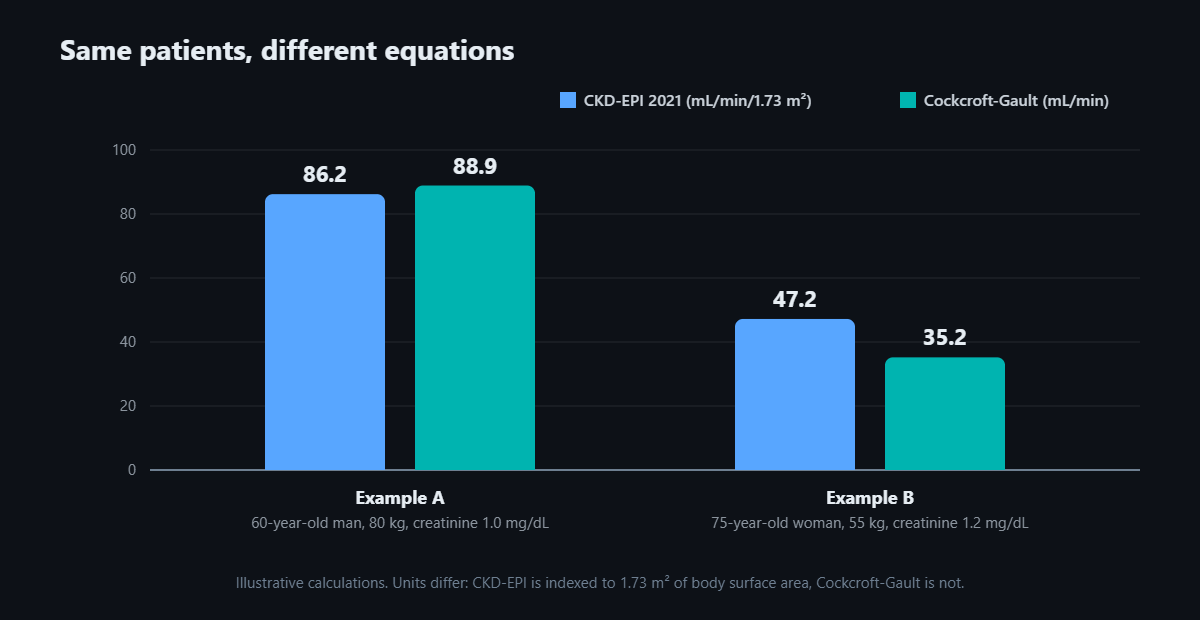
In Example A the two estimates agree closely. In Example B they differ by about a third: the patient is older and light, Cockcroft-Gault uses actual weight and is not indexed to body surface area, and the outputs are in different units. Neither number is “wrong”; they answer slightly different questions.
Reading the results
- For contrast decisions, follow your local policy and current guidance for the specific agent.
- For drug dosing, use the equation named in that drug’s labelling.
- If estimates disagree widely, check the inputs first (units, weight, age), then consider whether another marker such as cystatin C is warranted.
- Treat any single estimate as an approximation with real uncertainty.
When estimates are unreliable
- Acute kidney injury: creatinine is not at steady state, so equations can mislead.
- Extremes of body size or muscle mass, such as amputation, malnutrition or very high muscle mass.
- Children: these are adult equations; paediatric patients need paediatric methods.
- Pregnancy and some medications that alter creatinine handling.
Common mistakes
- Mixing mg/dL and µmol/L.
- Treating eGFR and creatinine clearance as interchangeable because both are quoted in “mL/min”.
- Using a value from weeks ago for a patient whose condition has changed.
- Treating a calculator as a decision-maker rather than one input to a clinical decision.
Key takeaways
- Several equations answer slightly different questions.
- CKD-EPI 2021 is a general-purpose adult eGFR; Cockcroft-Gault gives creatinine clearance and is still cited for drug dosing.
- Always check units and inputs before interpreting.
- Local protocols and the responsible clinician make the decision.
Frequently asked questions
Which equation should I use before contrast?
Use the one your department’s policy specifies. This article is educational and does not set thresholds.
Why does SpinCalc show several results instead of one?
Side by side, the differences become visible, so you can see when the choice of equation matters and when it does not.
Is SpinCalc a medical device?
No. It is provided for research and education. Results support, and never replace, clinical judgement.
References and further reading
- Inker LA, et al. New creatinine- and cystatin C-based equations to estimate GFR without race. N Engl J Med. 2021;385:1737-1748.
- Cockcroft DW, Gault MH. Prediction of creatinine clearance from serum creatinine. Nephron. 1976;16:31-41.
- Levey AS, et al. Using standardized serum creatinine values in the MDRD study equation for estimating glomerular filtration rate. Ann Intern Med. 2006;145:247-254.
- American College of Radiology. ACR Manual on Contrast Media (current edition).
Related articles
Last reviewed: 4 November 2026. Educational content for researchers, clinicians and students. It does not replace local protocols, manufacturer guidance or clinical judgement.