pCASL vs PASL: how arterial spin labelling labels blood

Learning objectives
- Explain the difference between pseudo-continuous (pCASL) and pulsed (PASL) labelling
- Know the 2015 consensus default timings
- Understand why the post-labelling delay must exceed the arterial transit time
- Know which readout and background suppression the consensus recommends
The idea in one line
Arterial spin labelling (ASL) magnetically labels the water in arterial blood, waits for it to reach the brain, and subtracts a label image from a control image. The small difference, about 1% of the signal, is proportional to cerebral blood flow (CBF). The basics are covered in Arterial spin labelling in plain English.
Two ways to label
| pCASL | PASL | |
|---|---|---|
| How | A long train of short RF pulses labels blood as it flows through a thin plane in the neck | A single inversion pulse labels a thick slab of blood below the imaging region |
| Label duration | Set directly (τ, typically 1.8 s) | Set by the slab and a saturation pulse at TI₁ (QUIPSS II) |
| Labelling efficiency (α) | About 0.85 | About 0.98 |
| SNR | Higher | Lower |
| Consensus status | Recommended default | Alternative when pCASL is unavailable |
Default timings (adults)
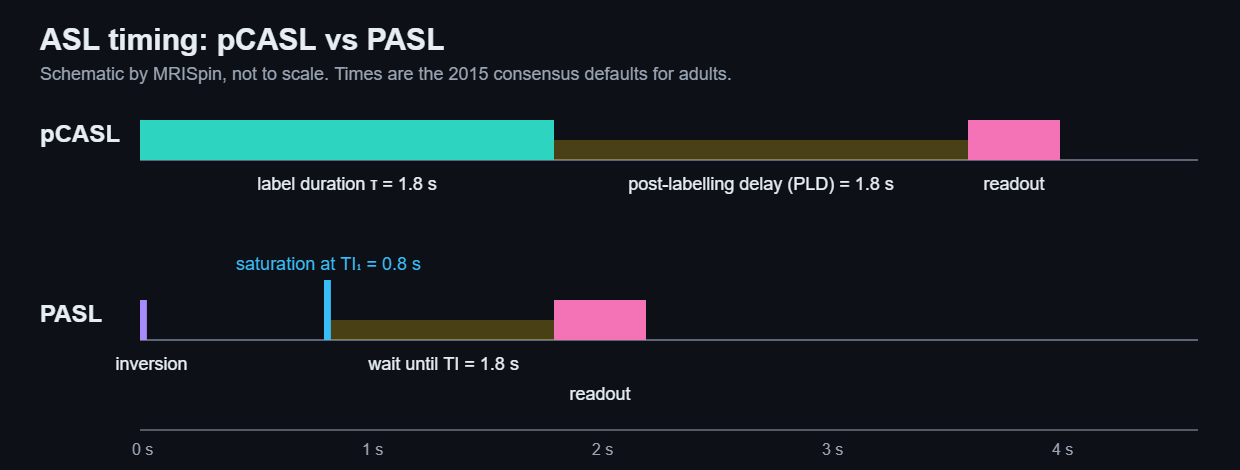
- pCASL: label duration 1800 ms; post-labelling delay (PLD) 1800 ms for adults under 70, 2000 ms for older adults and many patients, 2000 ms for neonates and 1500 ms for children.
- PASL: TI₁ 800 ms and TI 1800 ms.
- Readout: a segmented 3D sequence (3D GRASE or stack-of-spirals) with background suppression.
Why the delay matters
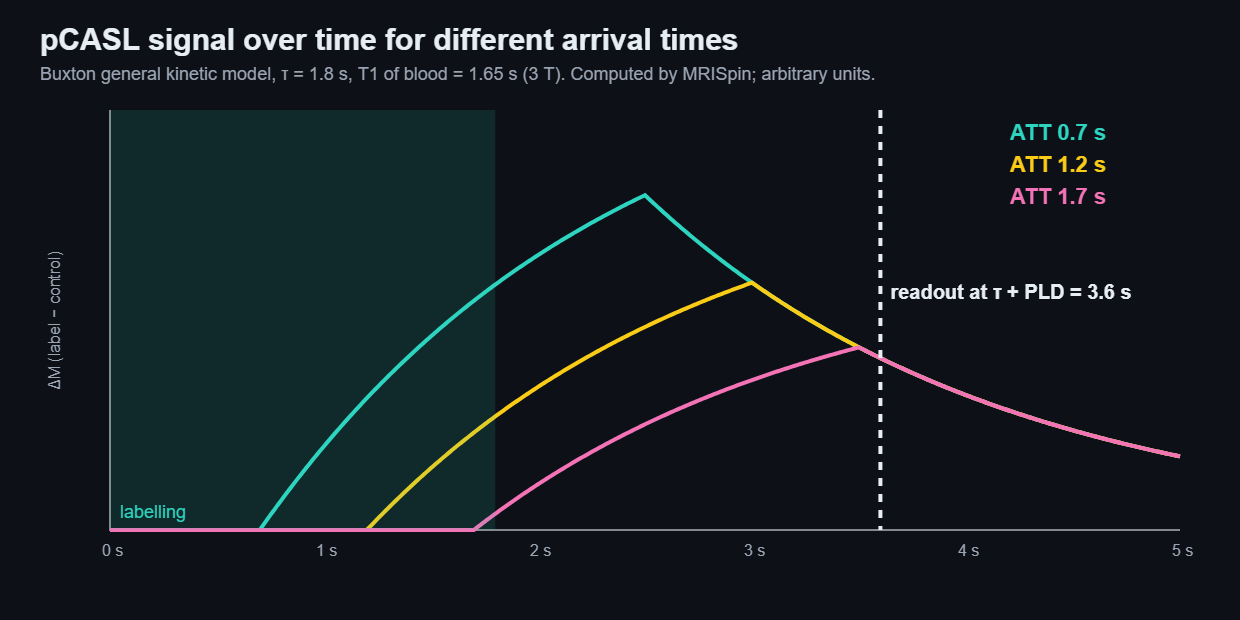
Labelled blood needs time to travel from the labelling plane to the tissue: the arterial transit time (ATT). If the image is acquired before all the label has arrived, CBF is underestimated and the delayed blood can still be in the arteries, giving bright vessels. With a PLD longer than the longest ATT, the signal at readout no longer depends on transit time, as the curves above show. In older people and in vascular disease ATT is longer, which is why longer delays or multi-delay ASL are used.
From signal to CBF
For single-delay pCASL the consensus model is:
CBF = 6000 · λ · ΔM · e^(PLD / T1b)
      ─────────────────────────────────────────────
      2 · α · T1b · M0 · (1 − e^(−τ / T1b))

λ = 0.9 mL/g   α = 0.85   T1b = 1650 ms (3 T)
CBF in mL/100 g/min
A worked example with Python is in ASL quantification: from label–control difference to CBF.
Key points
- pCASL is the recommended default; PASL is the alternative.
- Use a PLD longer than the transit time: 1.8–2.0 s in adults.
- Use a 3D segmented readout with background suppression.
References
- Alsop DC, Detre JA, Golay X, et al. Recommended implementation of arterial spin-labeled perfusion MRI for clinical applications: a consensus of the ISMRM perfusion study group and the European consortium for ASL in dementia. Magn Reson Med 2015;73(1):102–116.
- Buxton RB, Frank LR, Wong EC, Siewert B, Warach S, Edelman RR. A general kinetic model for quantitative perfusion imaging with arterial spin labeling. Magn Reson Med 1998;40(3):383–396.
Related articles
- Arterial spin labelling in plain English
- ASL timing: post-labelling delay and arterial transit time
- ASL quantification: from label–control difference to CBF
Last reviewed: 12 November 2026. Educational content for researchers, clinicians and students. Values are typical examples; local protocols, scanner software and manufacturer guidance take priority.