
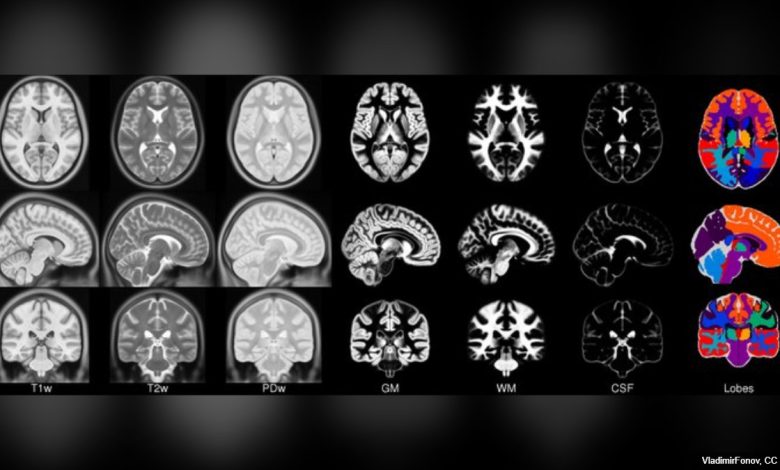
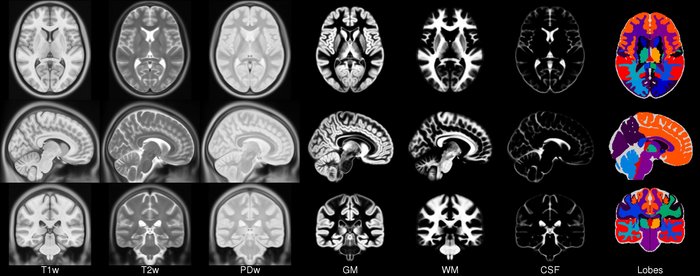
Registration is the process of aligning one image to another, for example mapping a subject’s scan to a standard template. ANTs (Advanced Normalization Tools) is known for high-quality non-linear registration, notably the SyN algorithm, along with bias-field correction and other utilities.
Learning objectives
- Explain what registration does and why it is needed.
- Distinguish rigid, affine and deformable transforms.
- Describe the role of similarity metrics.
- Run a basic ANTs registration and check the result.
Why register images?
To compare people, or the same person over time, you must put images in a common coordinate system. Registration finds the transform that makes corresponding anatomy overlap.
Types of transform
| Transform | Allows | Typical use |
|---|---|---|
| Rigid | Rotation and translation | Same person, same modality, head motion |
| Affine | Rigid plus scaling and shear | Initial alignment to a template |
| Deformable (e.g. SyN) | Local, smooth warping | Matching individual anatomy to a template |
Similarity metrics
The algorithm optimises a measure of how well the images match. Mutual information suits images of different contrasts. Cross-correlation suits images of the same contrast. Choosing the wrong metric is a common source of poor results.
A basic example
# Illustrative. Check your ANTs version and the script help text.
antsRegistrationSyN.sh -d 3 \
  -f template_T1w.nii.gz \
  -m sub-01_T1w.nii.gz \
  -o sub-01_to_template_
The script runs rigid, affine and SyN stages in sequence and writes the warped image and transform files.
Bias-field correction
ANTs includes N4 bias-field correction, which removes smooth intensity variation across an image and is often applied before registration or segmentation.
Checking the result
- Overlay the warped image on the template and look at ventricles, cortex edges and midline.
- Check for implausible folding in the deformation field.
- Do not rely on a similarity score alone.
Key takeaways
- Registration puts images into a common space.
- Use rigid or affine for simple alignment and deformable methods for anatomy matching.
- Match the metric to the image contrast.
- Always check the result visually.
SpinLab can generate a complete script for workflows like this from the steps you choose.
Frequently asked questions
ANTs or FSL for registration?
Both are widely used and give good results. The choice often depends on your pipeline, your data and the comparison you need to make.
References and further reading
- Avants BB, Epstein CL, Grossman M, Gee JC. Symmetric diffeomorphic image registration with cross-correlation: evaluating automated labeling of elderly and neurodegenerative brain. Med Image Anal. 2008;12:26-41.
- Tustison NJ, et al. N4ITK: improved N3 bias correction. IEEE Trans Med Imaging. 2010;29:1310-1320.
- ANTs documentation: github.com/ANTsX/ANTs
Related articles
- Getting started with FSL
- FreeSurfer recon-all: an overview
- BIDS basics
- Build a full pipeline with SpinLab
- Install ANTs on Windows with WSL 2
Last reviewed: 4 November 2026. Educational overview. Commands are illustrative: options change between versions, so check the official documentation for the version you install. Do not process identifiable patient data outside approved systems.