MRI quench and emergencies: helium, the quench pipe and which button to press

Learning objectives
- Explain what a quench is and why it is dangerous
- Know the difference between the magnet stop button and emergency power off
- Respond correctly to a cardiac arrest, a fire or a person pinned by a metal object
- Know the warning signs of a helium leak into the room
The magnet is always on
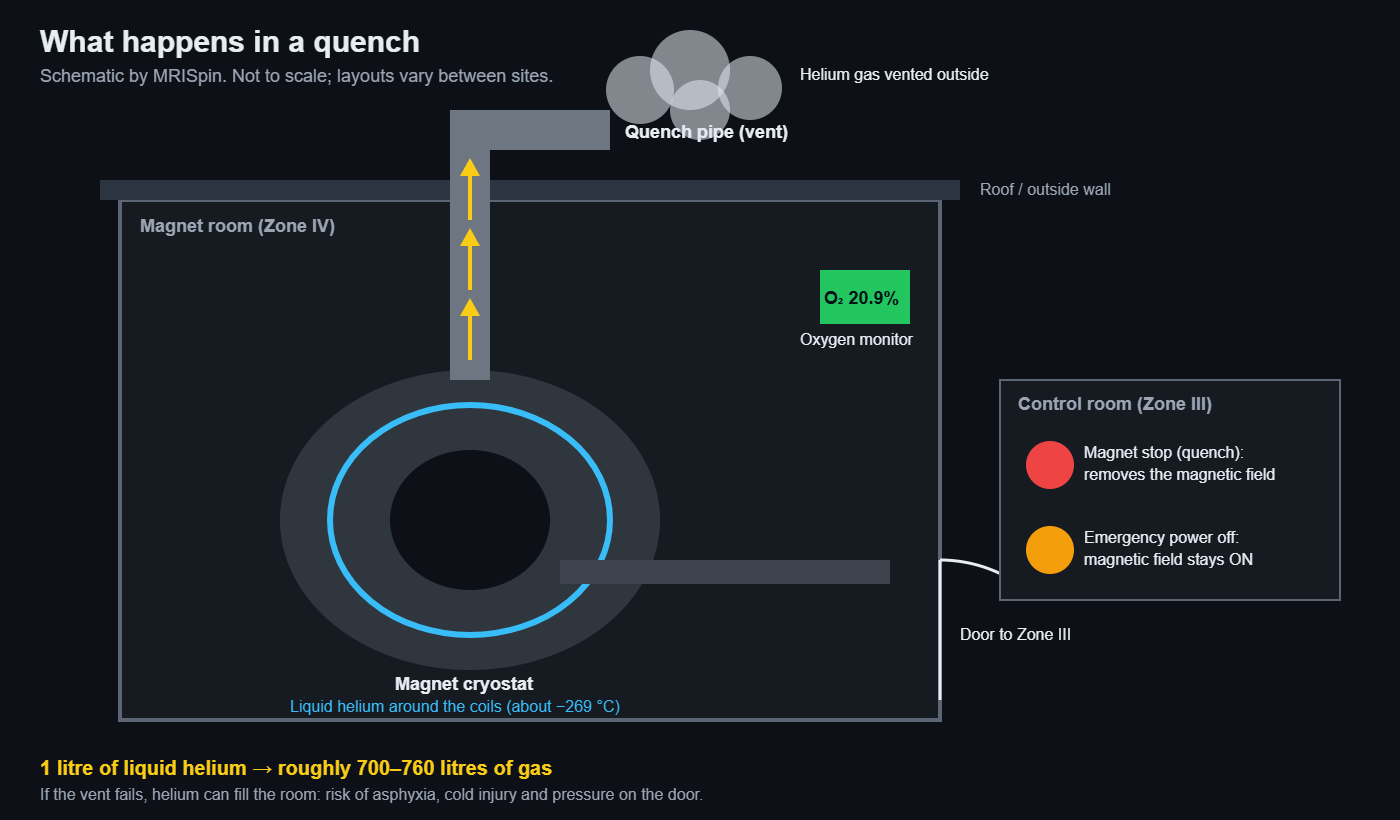
Almost all clinical MRI scanners use a superconducting magnet. Its coils are cooled by liquid helium to about −269 °C, where they carry current with no resistance. Once the magnet is ramped up, the field stays on day and night, even when the scanner software and lights are off.
What is a quench?
A quench is a sudden loss of superconductivity. The coil warms, the stored energy turns into heat, and the liquid helium boils off very quickly. One litre of liquid helium becomes roughly 700–760 litres of gas, so a large volume of very cold gas is produced in a short time. This gas must leave the building through the quench pipe.
A quench can happen spontaneously, or it can be started on purpose with the magnet stop button. The field falls over seconds to a minute or so, not instantly, and refilling and ramping the magnet afterwards takes days and is expensive.
If helium enters the room
If the quench pipe is blocked or damaged, helium can escape into the magnet room. Warning signs include a loud hissing, a white fog near the ceiling, and a falling reading on the oxygen monitor. Helium displaces oxygen and can cause asphyxia, the cold gas can cause cold burns, and the pressure can make an inward-opening door hard to open. Staff should get everyone out, keep the door open if possible, and not re-enter until the room has been ventilated.
Two different buttons
| Button | What it does | When to use it |
|---|---|---|
| Magnet stop (quench) | Removes the magnetic field by forcing a quench | A person trapped or injured by a ferromagnetic object pinned to the magnet; a fire where firefighters must enter the room |
| Emergency power off | Cuts electrical power to the scanner equipment | Electrical hazards, smoke or fire in equipment. The magnetic field stays on |
Common emergencies
- Cardiac arrest or collapse: start basic life support, move the patient out of the magnet room to Zone III, and continue resuscitation there. The resuscitation team and equipment must not enter Zone IV. Quenching the magnet is not part of the response.
- Fire: raise the alarm and evacuate. Tell the fire service that the magnet is still on; use only MR-safe extinguishers near the magnet. Quench only if firefighters must enter Zone IV with ferromagnetic equipment.
- Person pinned by an object: do not try to pull a heavy object off the magnet. Use the magnet stop button and call for help.
Zones and access are explained in MRI safety zones explained, and a real example of a machine pulled into a magnet is shown in MRI implant and device screening.
Key points
- The field stays on unless the magnet is quenched.
- Emergency power off does not remove the field.
- Resuscitate outside Zone IV; quench only for trapped people or when firefighters must go in.
References
- Medicines and Healthcare products Regulatory Agency (MHRA). Safety Guidelines for Magnetic Resonance Imaging Equipment in Clinical Use. London: MHRA; 2021.
- Kanal E, Barkovich AJ, Bell C, et al. ACR guidance document on MR safe practices: 2013. J Magn Reson Imaging 2013;37(3):501–530.
Related articles
Last reviewed: 7 November 2026. Educational content only. Every site must follow its own MR safety policy, the device manufacturer’s MR Conditional instructions and national guidance, under the direction of its MR safety expert and responsible staff.